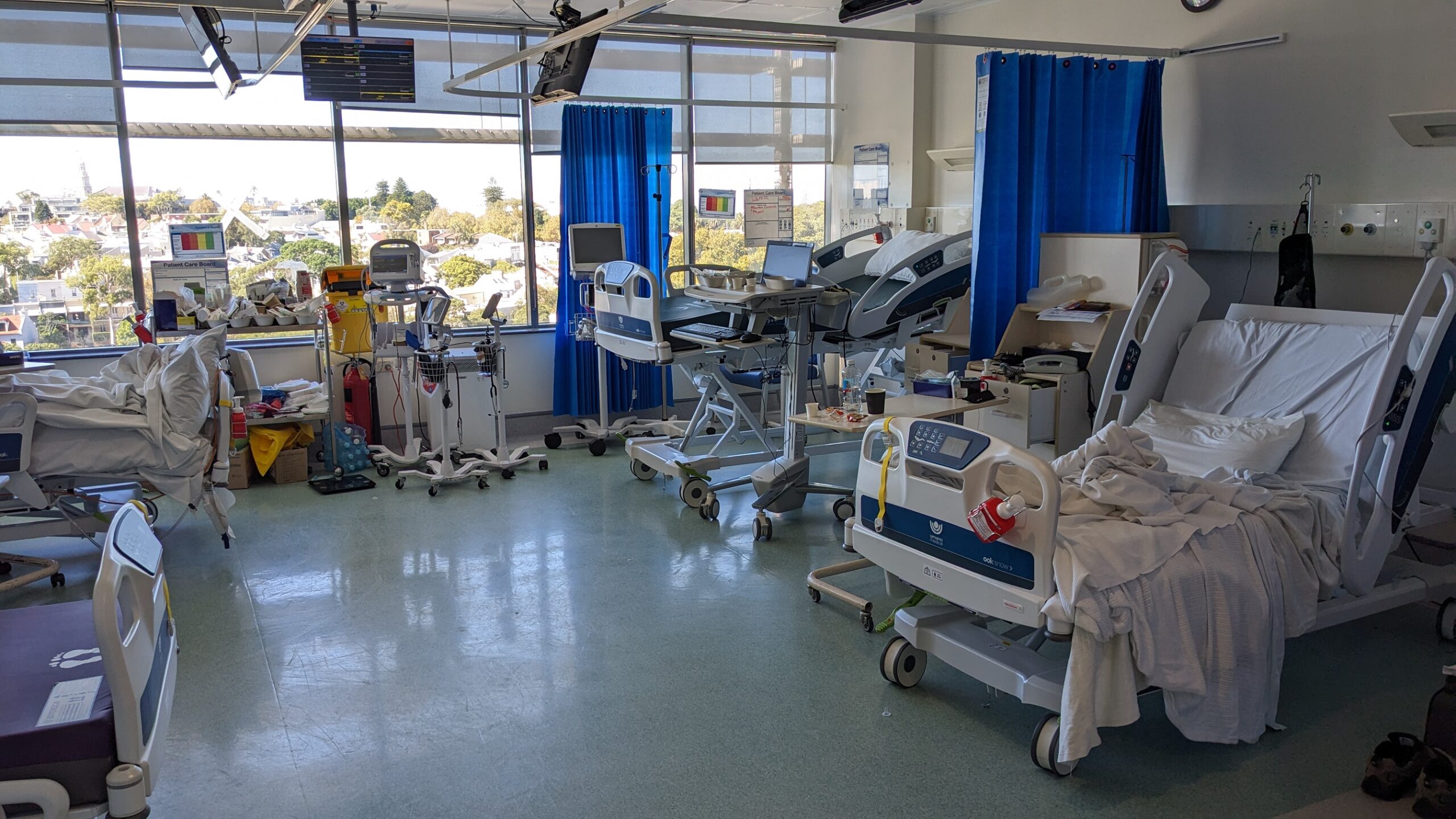
Then, they moved me into a 4-bed isolation ward (see my photo, above).
When I say isolation ward, I mean that access to the ward was restricted, all the staff entering wore the full protective gear: face shield, mask, plastic garment over their normal clothing, etc. No body suits, though.
By this time, I was feeling much better, and was starting to feel guilty that I was taking up a valuable bed. This feeling increased as I got to know my fellow ward-mates. Each of them had a significant underlying condition, plus COVID. One was one month into a heart transplant, one had had an emergency bypass and was pretty much out of it a lot of the time, another had a case of Staphylococcus aureus, and two of those also had diabetes. I only had COVID, without (I thought) any underlying conditions.
This morning, I got a delivery of my luggage. The hotel had packed up the luggage from my room, and sent it to the hospital via an Uber. Dr. Jasper enthusiastically brought them in to me.
Somewhere around this time, I asked what hospital I was in, as no one had told me when I was admitted. I was told that I was in St. Vincent’s Hospital.
I would hear conversations that the staff had with the other patients in the ward, where they would often try to ascertain the level of awareness of the patient by asking questions of them. One such question was “Tell me the months of the year, starting with December, and going backwards in time.” — Try it!
Another one was “What hospital are you in?” — I would not have been able to answer that during my first few days in this hospital!
I contacted Neb to tell him what had happened to me, and discovered, to my chagrin, that I had apparently infected both Neb and Alice with COVID! He told me that Alice’s symptoms were mild; Neb’s were a little more like a bad cold, so he wasn’t a happy camper. I apologized, but we all realized that there was nothing we could have done.
My assigned doctor, Jasper (everyone went by first names — nurses, cleaners, doctors, physiotherapists, etc.) told me that they had done a blood test on me, and it indicated that I might have a heart issue. They were concerned that COVID might have affected my heart, as it is known to do in some patients. As a result, he wanted to perform a test — it turned out to be a CT Scan of the heart — but couldn’t until I tested negative for COVID. Presumably, I would contaminate the big very valuable CT scanner; clearly not a good thing.
In all, I stayed in this 4-bed isolation ward from Tuesday, 28 March, until Monday, 3 April. During my stay, I wore a halter connected up to electrodes stuck over my chest. This way, they could monitor our simple vital signs, and we could see them displayed on an overhead screen. Alarms would sound if things went out of standard measures.
During the night, nurses would come around, every four hours, with a battery powered device on wheels, and take my blood pressure, heart rate, and oxygen level. Every patient in the ward was treated this way. During the day, there were similar regular checks, plus ensuring that we took our medications, and providing various IV liquids, if needed. And, of course, meals.
I have Bradycardia (slow heart rate), and this caused them some concerns, especially when, at night, my heart rate dropped below what they considered to be normal. More than once, I was woken up by a nurse to check my vital signs because of this, and a doctor would stop by and ask me if I was experiencing any symptoms of dizziness or light-headedness, chest pain, etc. I always said no to all of these questions.
We would have regular ECGs, too. The number of items of equipment available, often mobile, battery powered, rechargeable, machines was amazing. They were very well equipped.
After the 5 day point, they tested me again for COVID, but I was still positive.