
The antipodes of any place on the Earth is the point on the Earth’s surface which is diametrically opposite to it. Two points that are antipodal to each other are connected by a straight line running through the centre of the Earth. An antipodal point it is often called an antipode.
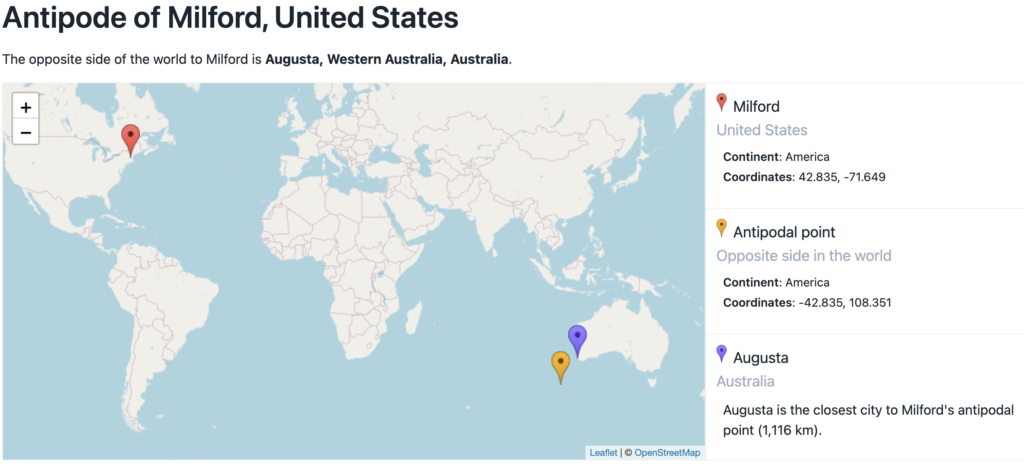
The above image was taken from a website where you can determine the antipodal point of any location on earth: https://www.geodatos.net/en/antipodes/united-states/milford-nh
That web page also lists:
Cities on the other side of the world of Milford
This table contains the populated locations that are closest to Milford’s antipode. These are the farthest cities in the world from Milford.
| City | Country | Distance from antipode | Coordinates |
|---|---|---|---|
| Augusta, WA | Australia | 1,116 km | (-34.316, 115.159) |
| Gnarabup, WA | Australia | 1,139 km | (-33.993, 114.996) |
| Pemberton, WA | Australia | 1,146 km | (-34.443, 116.037) |
| Margaret River, WA | Australia | 1,147 km | (-33.955, 115.076) |
| Cowaramup, WA | Australia | 1,158 km | (-33.850, 115.104) |
| Ocean Beach, WA | Australia | 1,163 km | (-35.014, 117.290) |
| Shadforth, WA | Australia | 1,166 km | (-34.964, 117.269) |
| Manjimup, WA | Australia | 1,170 km | (-34.241, 116.146) |
| Denmark, WA | Australia | 1,171 km | (-34.961, 117.353) |
| Youngs, WA | Australia | 1,175 km | (-35.017, 117.517) |
Placenames ending in “up”
If you’re curious about the above placenames that end in an “-up” suffix, here’s an explanation from Wikipedia: https://en.wikipedia.org/wiki/-up:
-up is a suffix commonly found in place names in south western Western Australia.
The suffix originated in a dialect of Noongar, an Australian Aboriginal language, in which “-up” means “place of”. The suffix “-in” or “-ing” has a similar meaning in a related dialect of Noongar.[1] Places tended to be named after their distinctive features, whereby the place names could be used to create a “mental map” allowing Indigenous Australians to determine where water, food and other raw materials could be found. These sites were often located near sources of fresh water, leading to the common misconception that “up” and “in” mean “near water”.
The meanings and the pronunciations of many of these names has been lost over time.
https://en.wikipedia.org/wiki/-up
In particular:
- Cowaramup meaning believed to be derived from cowara, the Aboriginal name for the purple-crowned lorikeet (Glossopsitta porphyrocephala)
- Manjimup is said to be derived from “Manjin”, a broad leafed marsh reed with an edible root