|
| |
The Primitive
Data Types are:
boolean, char, byte, short, int, long, float, double
Everything else is a Reference
Type
For example:
Grommet g,h;
g = new Grommet();// g refers to a Grommet object
h = g;            // h refers to the same Grommet object
Major Differences
Between Primitive and Reference Types
| Primitive
Types |
Reference
Types |
Can be declared locally within a
function.
|
References can be declared locally,
but the objects themselves are always newed from the heap.
|
Assigning one to another copies the
value.
|
Assigning one to another adds a
new reference to an object.
To copy one object to another, you use the clone() method.
|
Function arguments passed by
value.
|
Function arguments passed by
reference. (Arguments are 'references,
passed by value'.)
|
== and
!= operators compare values.
|
== and
!= operators test whether references refer
to the same object.
To compare values, you typically use the equals() method.
|
Each type has a default initial
value.
|
Initial value of a reference is null, meaning absence of reference. You
can explicitly set a reference to null by assigning it.
|
Other Points
Java has no pointers!!!
- This is goodness -- believe me!
- It isn't as restrictive as you
might first think, if you're a C or C++
programmer.
You always use the new operator to create an instance of a class
(object)
- There is no delete operator!
- Java takes care of cleaning up
using a technique called garbage collection.
Here's How References
Work:
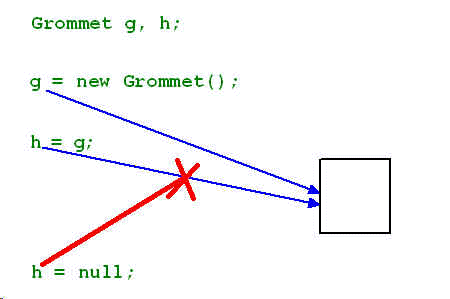
- Each assignment adds a new reference
to the object.
- Each assignment from null removes the
reference to the object.
- When the reference count goes to zero,
the object is a candidate for garbage collection.
Summary of Reference Types (Java in a Nutshell, Flanagan)
- All objects and arrays are
handled by reference.
- The references themselves
are passed by value to methods.
- The = and
== operators assign and test
references.
- Use clone() to copy an object
- Use equals() to test that two different
objects 'are equal' (have the same value)
- The referencing and
dereferencing is handled automatically by Java.
- A reference type can never
be cast to a primitive type
- A primitive type can never
be cast to a reference type
- There is no pointer
arithmetic in Java
- There is no sizeof operator in Java
- null is a special value that means
'no object' or 'absence of reference to object'.
|
