Ragù Bolognese
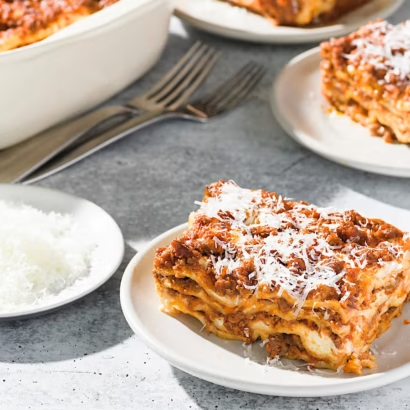
This recipe makes enough ragù for lasagna Bolognese with enough leftovers for another night's pasta dinner. Try to purchase pancetta in a large chunk from the deli counter, and if it comes in casing-like plastic, make sure to remove and discard the wrap before use. The next best option is packaged already diced pancetta; if pre-sliced is the only option, it will work, but will cost a lot more and requires less time in the food processor. We add a bit of powdered gelatin to give the ragù a rich, velvety body that otherwise would require a lengthy simmer to achieve. The finished ragù can be cooled to room temperature and refrigerated for up to three days.Don’t trim the fat from the beef and pork. The fat makes the ragù rich and supple, and carries the flavors of the other ingredients. Don’t process the beef and pork too finely; a coarse grind yields the best-textured sauce.
Servings: 8 cups (approx.)
Ingredients
Meat
- 1½ lbs beef short ribs boneless
- 1 8-oz piece pancetta
- 1 lb pork shoulder boneless
Produce
- 4 bay leaves
- 1 medium carrot
- 1 medium celery stalk
- 2 28-oz cans whole tomatoes
- 1 large yellow onion
Canned Goods
- 2 cups beef broth low-sodium
- ¼ cup tomato paste
Baking & Spices
- 1 Kosher salt and ground black pepper
- ½ tsp red pepper flakes
Oils & Vinegars
- 3 Tbsp extra-virgin olive oil
Dairy
- 4 Tbsp salted butter
Desserts
- 2 Tbsp unflavored powdered gelatin
Beer, Wine & Liquor
- ½ cup dry white wine
Instructions
- In a large Dutch oven, combine the butter and oil. In a food processor, pulse the onion, celery and carrot until roughly chopped, about 5 pulses. Transfer to the Dutch oven. One can at a time, add the tomatoes with juices to the food processor and puree until smooth; transfer to a medium bowl. Add half the beef to the food processor and pulse until coarsely ground, 5 to 10 pulses, then transfer to another medium bowl; repeat with the remaining beef. Repeat with the pork, in batches, adding it to the beef. Finally, process the pancetta to a coarse paste, about 30 seconds; add to the other meats.
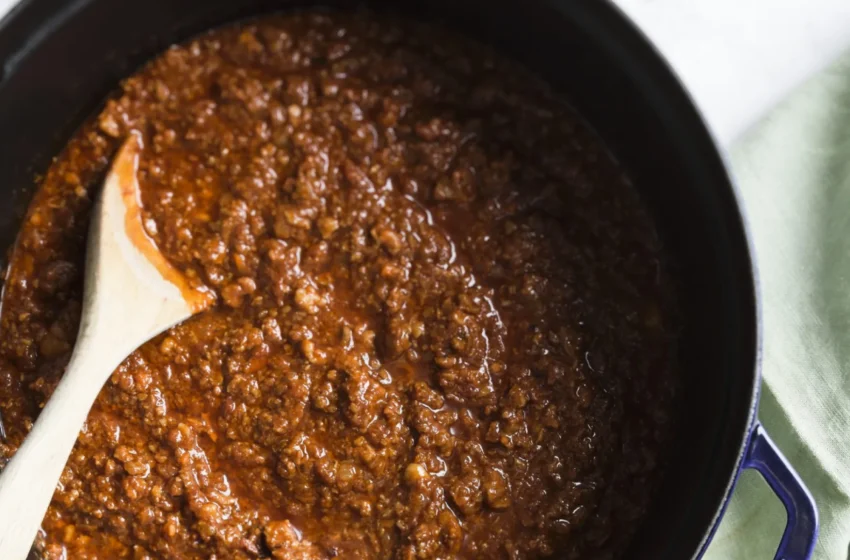
- Set the pot over medium-high and cook, stirring occasionally, until the vegetables are lightly browned, about 5 minutes. Stir in the tomato paste and cook, stirring, until the paste begins to brown, about 5 minutes. Add the wine and cook, scraping up any browned bits, until the pot is almost dry, about 1 minute. Stir in the ground meats, then stir in the broth, tomatoes, bay and pepper flakes. Bring to a simmer, then partially cover, reduce to medium-low and cook, stirring occasionally, until the meat is tender, the sauce is thick and the volume has reduced to about 8 cups, 2½ to 3 hours. Remove the pot from the heat.
- Pour ¼ cup water into a small bowl and sprinkle the gelatin evenly over the top; let stand for 5 minutes to soften. Meanwhile, taste and season the ragù with salt and pepper, then remove and discard the bay. Stir in the softened gelatin until fully dissolved.
Notes
We learned how to make ragù Bolognese at chef Alberto Bettini’s Michelin-starred Amerigo restaurant outside Bologna. After several tests in the Milk Street kitchen, we determined beef and pork that we ground ourselves in a food processor yielded superlative flavor and texture; supermarket ground meats made insipid sauces. Also, try to purchase pancetta in a large chunk from the deli counter, and if it comes in casing-like plastic, make sure to remove and discard the wrap before use. The next best option is packaged already diced pancetta; if pre-sliced is the only option, it will work, but will cost a lot more.
Since the ragù demands several hours of slow simmering, we depend on the oven to get the job done, as its even, steady heat means hands-off cooking. The amount of fat that rises to the surface of the finished sauce will vary, depending on the fattiness of the meats. When cooking is complete, skim off and discard as little or as much as you like, bearing in mind that at least some is desirable for silkiness and richness of flavor.
The finished ragù can be cooled to room temperature and refrigerated for up to three days. This recipe makes enough sauce for lasagna Bolognese, with leftovers for another night’s pasta dinner.