|
|
|
|
NO! It is important to recognize that, in any given project, and especially in larger ones, the right solution is a suitable mix of JSPs and servlets. Why?
We want to discourage anyone who thinks that going completely JSP or completely servlet is a good idea. A mix of servlets and JSPs allows a project to separate the form from the function, and to farm out development and maintenance work to the appropriate person/group. For example, remember the code we wrote for a simple form data servlet? Here it is again:/*
* Form1Servlet.java
*
* Created on November 24, 2006
*/
package formExamples;
import java.io.IOException;
import java.io.PrintWriter;
import javax.servlet.ServletException;
import javax.servlet.http.HttpServlet;
import javax.servlet.http.HttpServletRequest;
import javax.servlet.http.HttpServletResponse;
/**
* A servlet to process the parameters from a form.
*
* @author Bryan Higgs
* @version
*/
public class Form1Servlet extends HttpServlet
{
/**
* Processes requests for both HTTP <code>GET</code> and <code>POST</code> methods.
* @param request servlet request
* @param response servlet response
*/
protected void processRequest(HttpServletRequest request, HttpServletResponse response)
throws ServletException, IOException
{
response.setContentType("text/html; charset=UTF-8");
PrintWriter out = response.getWriter();
String docType = "<!DOCTYE html PUBLIC \"-//w3c//DTD XHTML 1.0 Strict//EN\"" +
" \"http://www.w3c.org/TR/xhtml1/DTD/xhtml1-strict.dtd\">\n";
out.println(docType);
out.println("<html>");
out.println("<head>");
out.println("<title>Servlet Form1Servlet</title>");
out.println("</head>");
out.println("<body>");
out.println("<h1>Servlet Form1Servlet at " + request.getContextPath () + "</h1>");
out.println("<ul>");
out.println( "<li><b>first-name:</b> " + request.getParameter("first-name") + "</li>");
out.println( "<li><b>last-name:</b> " + request.getParameter("last-name") + "</li>");
out.println( "<li><b>occupation:</b> " + request.getParameter("occupation") + "</li>");
out.println("</ul>");
out.println("</body>");
out.println("</html>");
out.close();
}
/**
* Handles the HTTP <code>GET</code> method.
* @param request servlet request
* @param response servlet response
*/
protected void doGet(HttpServletRequest request, HttpServletResponse response)
throws ServletException, IOException
{
processRequest(request, response);
}
/**
* Handles the HTTP <code>POST</code> method.
* @param request servlet request
* @param response servlet response
*/
protected void doPost(HttpServletRequest request, HttpServletResponse response)
throws ServletException, IOException
{
processRequest(request, response);
}
/**
* Returns a short description of the servlet.
*/
public String getServletInfo()
{
return "Short description";
}
}
Here's the equivalent JSP: <!DOCTYE html PUBLIC "-//w3c//DTD XHTML 1.0 Strict//EN"
"http://www.w3c.org/TR/xhtml1/DTD/xhtml1-strict.dtd">
<html>
<head>
<title>JSP Form1JSP</title>
</head>
<body>
<h1>JSP Form1JSP at <%= request.getContextPath() %></h1>
<ul>
<li><b>first-name:</b> <%= request.getParameter("first-name") %></li>
<li><b>last-name:</b> <%= request.getParameter("last-name") %></li>
<li><b>occupation:</b> <%= request.getParameter("occupation") %></li>
</ul>
</body>
</html>
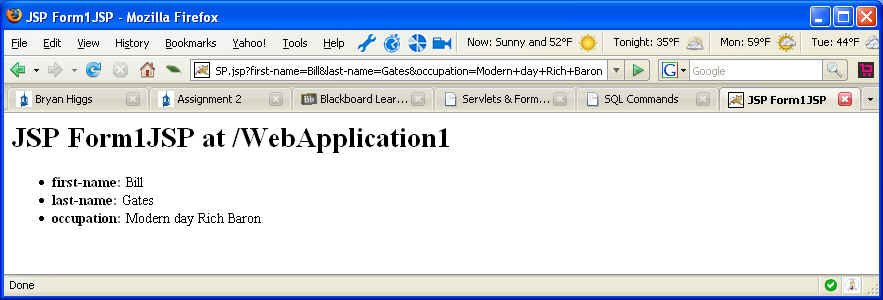
Here's what it outputs:
Does that convince you that it's a lot less effort to implement presentation using a JSP? |
| The page was last updated February 19, 2008 |